Proudly serving Mesa, Tempe & surrounding areasCall or Text 24/7: 602-905-5577

Mesa Water Softeners - Installation, Reverse Osmosis & Whole House Filtration

Mesa Water Softeners provides water softener installation, reverse osmosis, whole-house filtration, water softener repair and maintenance, and complete water treatment services. We help reduce hard water scale, protect appliances, improve water taste, and extend the life of plumbing, fixtures, and water heaters with systems sized around tested water hardness, water usage, and site-specific plumbing needs.

Our team works with salt-based water softeners, saltless conditioners, carbon filtration, sediment pre-filters, reverse osmosis systems, and high-capacity commercial water treatment equipment. Every project starts with water testing for calcium, magnesium, chlorine or chloramines, iron, sediment, and dissolved solids so we can recommend the right system for your home or business.

Serving Mesa, AZ, and the surrounding East Valley, including Eastmark, Cadence, West Mesa, and North Mesa, our certified technicians install clean plumbing connections, bypass valves, and drain lines, then program your system for actual water use. Schedule a consultation to compare softeners, filtration options, repair needs, and maintenance support with clear recommendations and upfront pricing.

★ ★ ★ ★ ★4.9/5 Average Rating · 20+ Years of Experience · thousands of Customers Helped · Licensed & Insured · Residential & Commercial
Mesa Water Treatment Experts

Water Hardness Test
Softener Installation
Reverse Osmosis
Whole House Filtration
Core Services

Water Treatment Services

Our core service lineup starts with water softener installation, reverse osmosis, and whole house filtration because those are the highest-impact upgrades for Mesa water. From there, we support repair, maintenance, residential and commercial systems, salt-based and saltless softeners, and carbon treatment when testing supports them. Each recommendation considers Mesa hardness readings above 300 ppm and well above 200 mg/L in many neighborhoods, Salt River Project and Central Arizona Project source blends, chloramine treatment, older neighborhood plumbing, and East Valley usage patterns.

Water Softener Installation

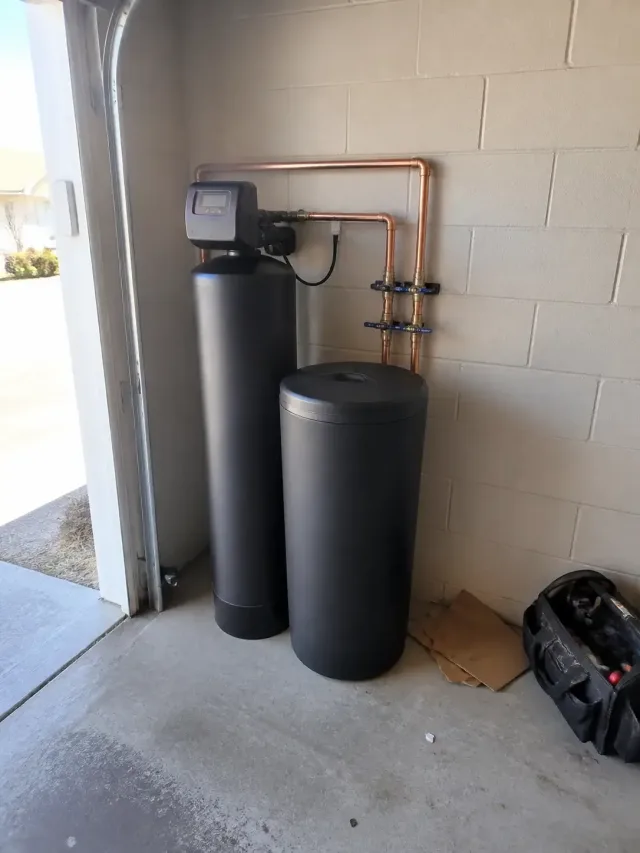
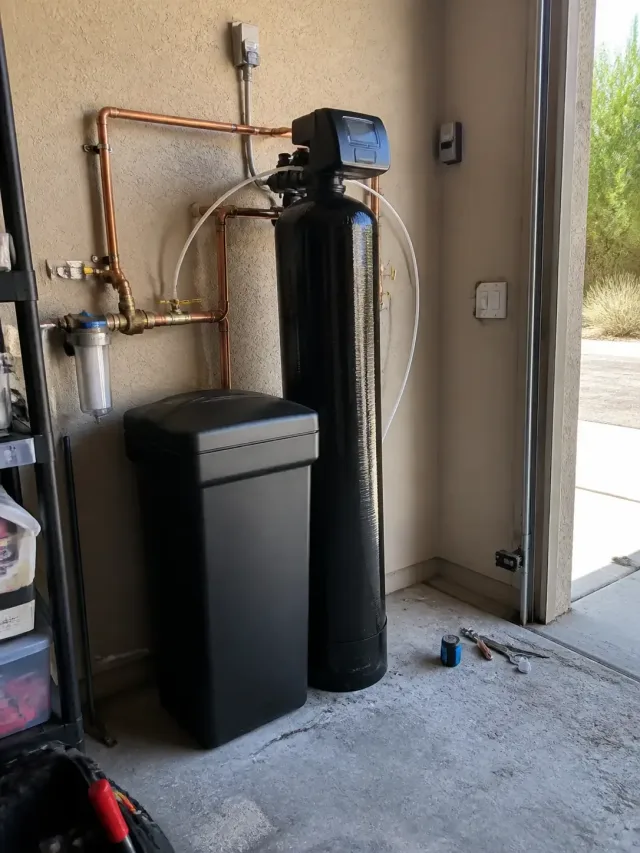
Newly installed black water softener system with copper piping in a Mesa, AZ garage.

We install water softeners for Mesa homes and businesses using water test results, actual usage needs, and plumbing layout as the basis for every recommendation. For many four-person Mesa households using roughly 75 gallons per person per day with local hardness often in the 17 to 25 grains-per-gallon range, that sizing work commonly points to a 32,000- to 48,000-grain system. Our technicians configure bypass valves, drain lines, brine tanks, and copper or PEX connections so the system is clean, accessible, and ready for daily use.

Explore Service

Reverse Osmosis

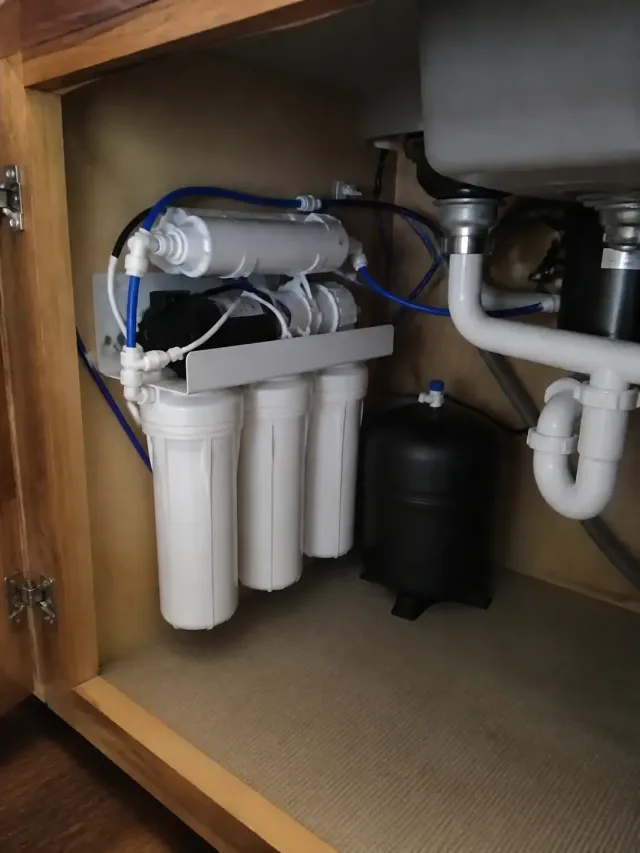
Reverse osmosis water filtration system installed under a kitchen sink in Mesa, AZ.

Reverse osmosis gives Mesa customers a focused drinking-water solution while the softener handles hardness throughout the home. We install under-sink and kitchen RO systems with membrane setup, storage tank placement, dedicated faucet installation, and plumbing connections for drinking and cooking water. RO is especially useful for dissolved solids, nitrates, chlorine, chloramines, and other contaminants that affect taste at the kitchen tap.

Explore Service

Whole House Filtration

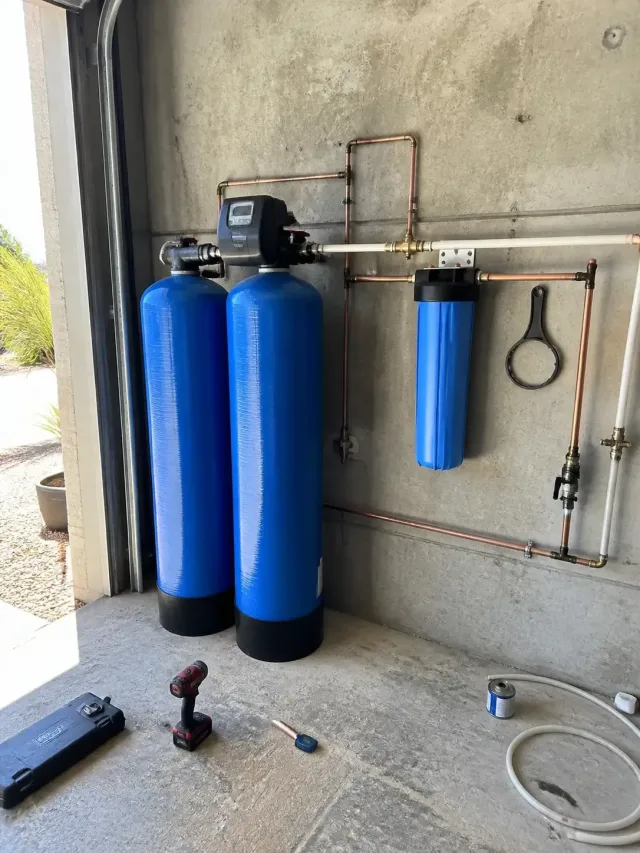
Whole house water filtration system with blue tanks and copper pipes installed in a garage in Mesa, AZ.

Whole house filtration is the right next step when testing shows issues beyond hardness, such as sediment, iron, hydrogen sulfide odor, chlorine, or chloramines. We install sediment pre-filters, iron reduction systems, catalytic carbon media, and multi-stage housings that protect the softener resin bed while improving water quality throughout the property. The system is selected around Mesa source-water conditions from Salt River Project and Central Arizona Project blends, not a generic one-size-fits-all filter.

Explore Service

Water Softener Repair

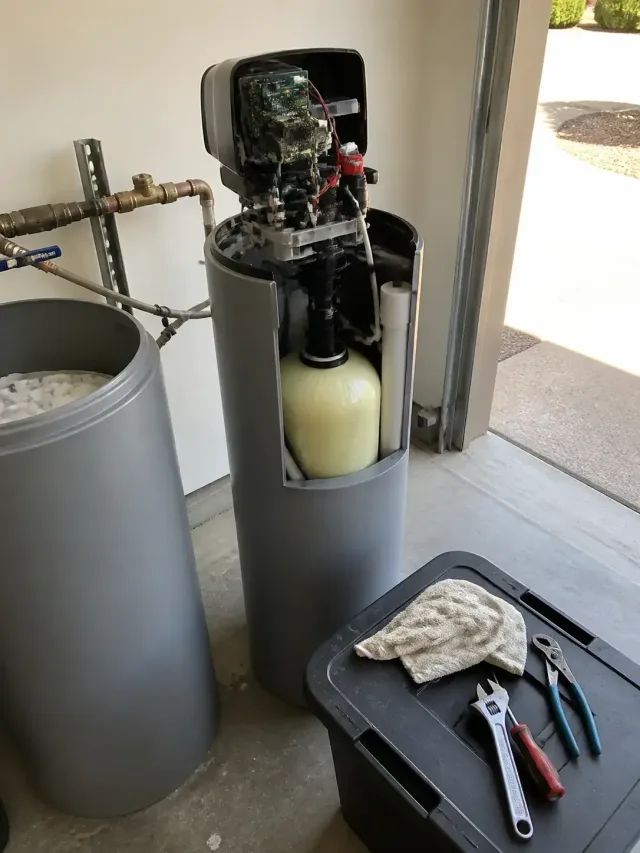
Water softener repair in progress with tools on a bin inside a garage in Mesa, AZ.

If your softener stops delivering soft water, uses too much salt, leaks near the control valve, or struggles to regenerate, we diagnose the issue before recommending parts. Common Mesa repair needs include failed control valves, resin degradation, salt bridges, injector and venturi problems, brine draw failures, and iron fouling of the resin bed. A methodical diagnosis often takes about 30 to 45 minutes and helps determine whether the system needs cleaning, programming, parts, resin media, or replacement.

Water Softener Maintenance

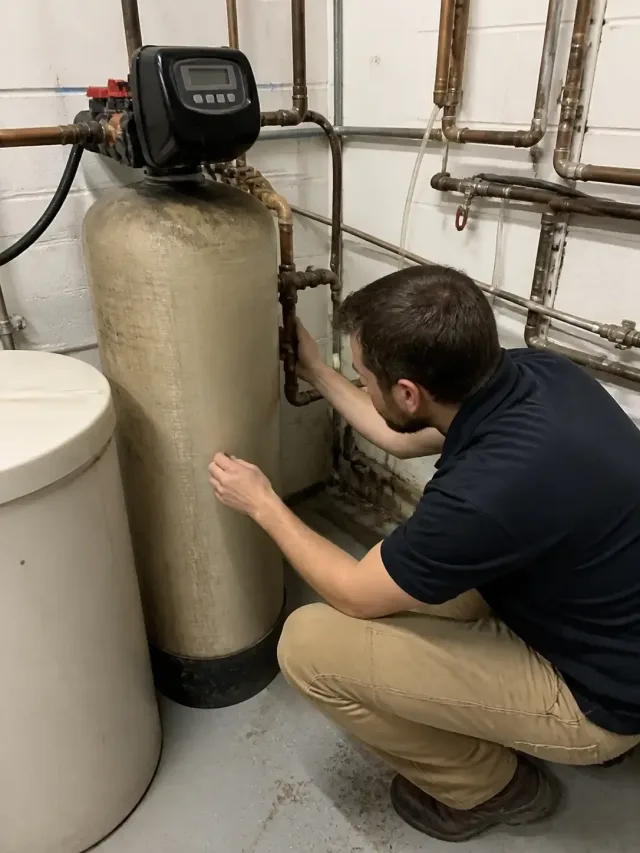
Technician inspecting an industrial water softener system in a utility room in Mesa, AZ.

Routine maintenance keeps a Mesa water softener from underperforming long before it fails. Service can include brine tank cleaning, resin bed inspection, salt level checks, control valve testing, regeneration-cycle verification, salt dosage adjustment, and output hardness testing at the tap. A quality system that is installed correctly and maintained properly often lasts 15 to 20 years. Commercial systems may also need scheduled resin testing, valve inspection, brine system servicing, and hardness verification at key points in the facility.

Residential Water Softener Systems

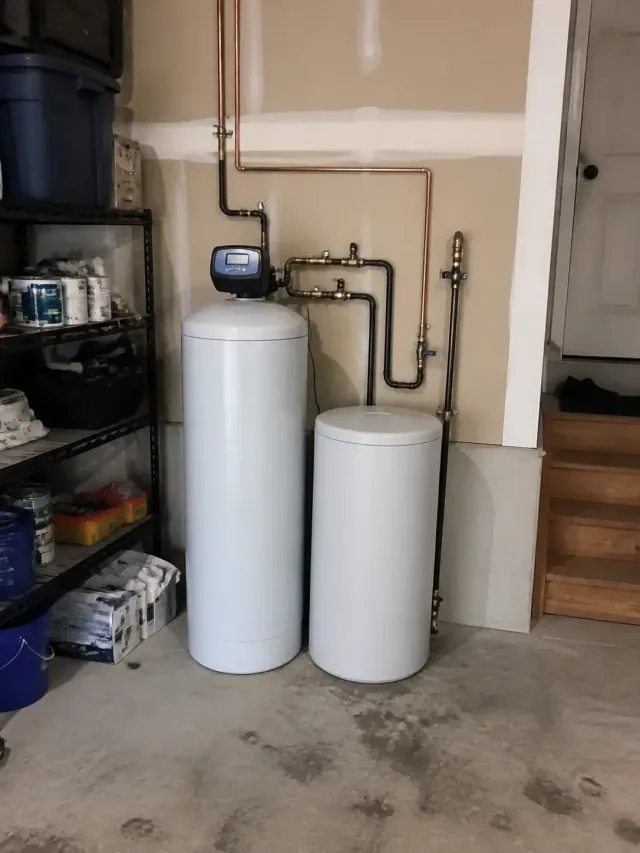
Newly installed residential water softener with two white tanks in a garage in Mesa, AZ.

A whole-home softener treats showers, laundry, dishwashers, ice makers, water heaters, and the cold supply to fixtures throughout the house. For Mesa homes, this whole-house approach helps reduce scale where hard water damage is most costly and least visible, especially in water heaters, dishwashers, washing machines, and coffee makers. Demand-initiated regeneration can base cycles on actual gallons used instead of a fixed timer, reducing wasted salt and water when the system is sized correctly.

Salt Water Softener Installation

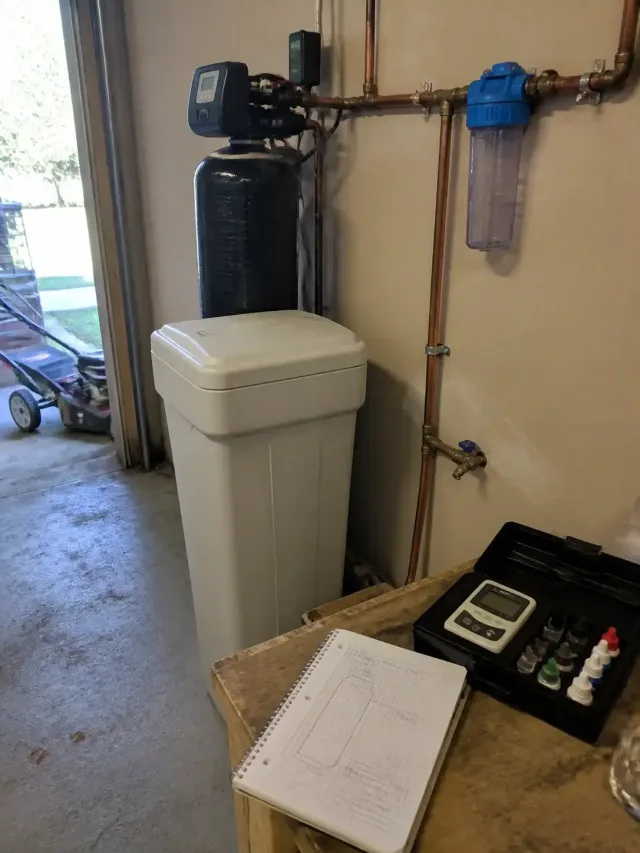
Newly installed salt water softener with copper piping in a residential garage in Mesa, AZ.

Salt-based ion exchange systems are widely used in Mesa because they reduce calcium and magnesium hardness minerals to near zero when properly sized. The resin bed exchanges hardness ions for sodium ions, then regenerates with brine so the mineral tank can keep treating local water that often measures well above 200 mg/L. We calculate grain capacity from water hardness and household usage so regeneration cycles happen at the right interval without wasting salt.

Saltless Water Softener Installation

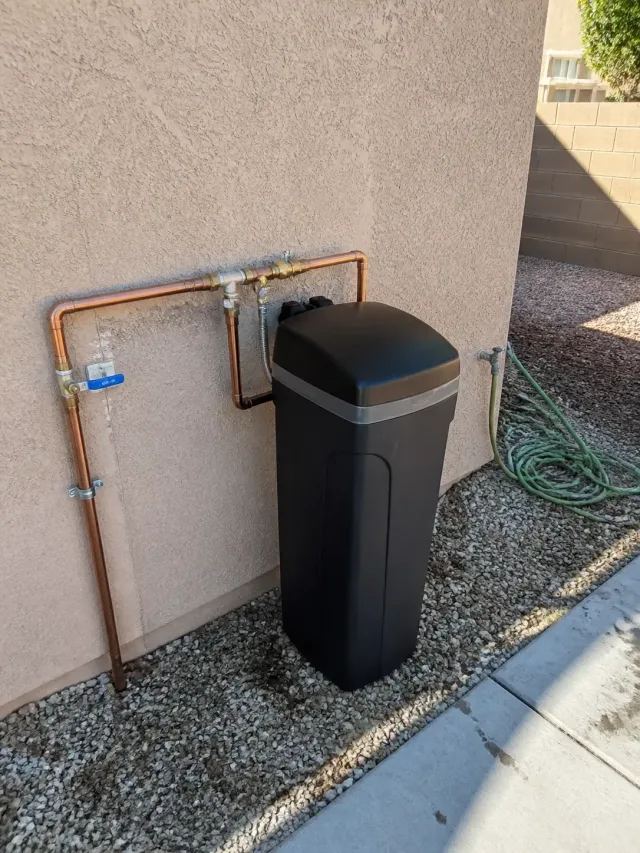
Newly installed saltless water softener connected to exterior plumbing at a home in Mesa, AZ.

Saltless conditioners, including template-assisted crystallization systems, alter hardness minerals so they are less likely to cling to pipes and fixtures rather than removing them from the water. They use no salt, electricity, or regeneration cycle, which can appeal to households with sodium concerns or specific maintenance preferences. Because Mesa hardness can run high, we compare saltless conditioning honestly against ion exchange before recommending it.

Commercial Water Softener Installation

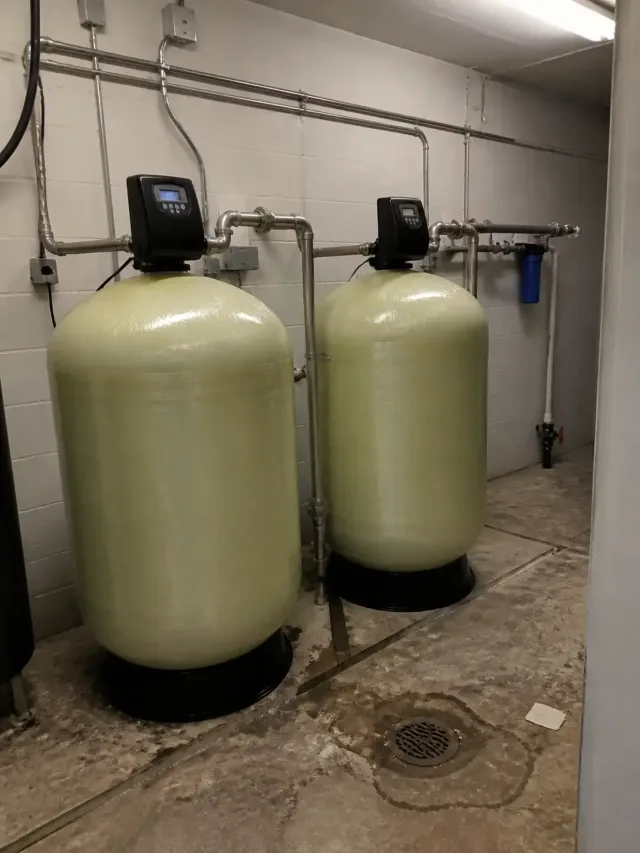
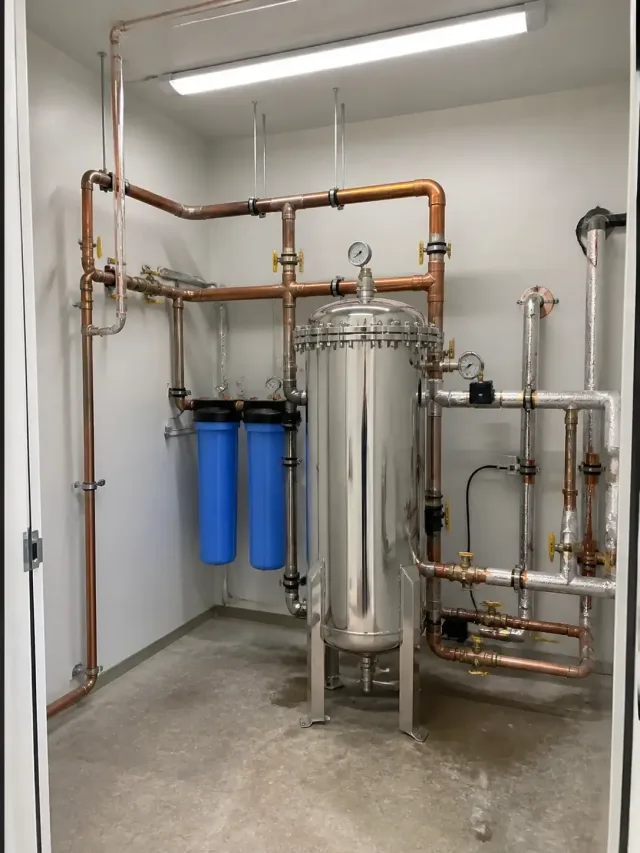
Commercial water softener system with stainless steel pipes installed in a mechanical room in Mesa, AZ.

Mesa restaurants, hotels, laundries, car washes, medical offices, and light manufacturing operations often need more capacity than a residential softener can provide. We design commercial systems around daily flow rate, water consumption, grain capacity, regeneration timing, and equipment needs, with options that can range from 48,000 grains to several hundred thousand grains. Duplex or triplex configurations can be used when a facility needs continuous soft water while another tank regenerates.

Carbon Filtration & Additional Treatment

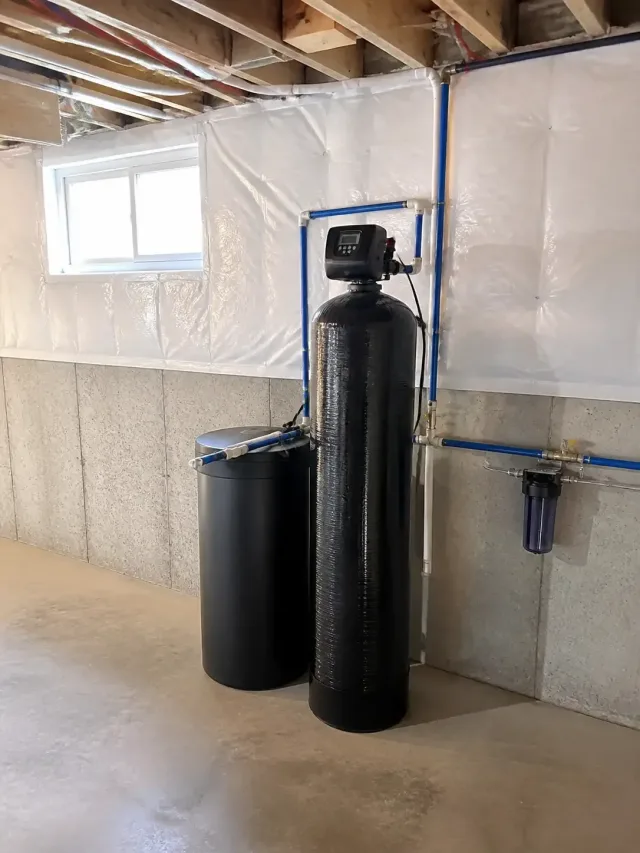
Water filtration system with blue and white plumbing pipes installed in a residential basement in Mesa, AZ.

Activated carbon filtration can improve taste and odor while reducing chlorine, chloramines, and volatile organic compounds at the point of treatment. Because Mesa municipal water is treated with chloramines rather than chlorine alone, we specify catalytic carbon media when testing and application call for it instead of treating every property with a generic standard-carbon setup. Carbon treatment can also be paired with sediment filtration, RO, or a softener as part of a staged system.

Advanced Services

Water Treatment Support Built for Mesa

The right water treatment plan depends on more than picking a tank from a catalog. Mesa hardness readings, Salt River Project and Central Arizona Project source blends, chloramine treatment, plumbing age, daily water use, commercial flow requirements, and filtration needs all affect which system will perform efficiently over time. We use those attributes to match equipment to the property instead of forcing one generic solution into every home or business.

Water filtration system installed in a residential garage in Mesa, AZ, with copper piping and a brine tank.

Custom Water Testing & System Sizing

Every recommendation begins with a water test and a sizing conversation. We look at hardness minerals, chlorine or chloramines, iron, sediment, dissolved solids, daily water use, fixture count, appliance exposure, Salt River Project or Central Arizona Project source-blend context, and household or business demand before recommending equipment.

  • Calcium and magnesium hardness readings in mg/L and grains per gallon
  • Checks for chloramines, iron, sediment, taste, odor, dissolved solids, and source-blend clues
  • Usage review based on occupants, fixtures, appliances, or business demand
  • Grain-capacity calculations for 32,000-, 48,000-, or larger systems when appropriate
  • Plain-language comparison of softening, RO, carbon, and sediment filtration
Water filtration system installed in a commercial facility in Mesa, AZ, with copper piping and a brine tank.

Professional Installation & Code-Aware Plumbing

Installation quality affects performance, access, and service life. Our technicians focus on neat plumbing layouts, correct bypass configuration, supported pipe runs, proper brine tank placement, and drain routing that follows local requirements for Mesa and Arizona plumbing work, including permit-aware loop connections when required.

  • Bypass valves labeled and configured for easy service
  • Drain lines routed to appropriate discharge points
  • Brine tanks positioned for safe salt access and cleaning
  • Clean copper or PEX connections with supported pipe runs
  • Demand-initiated programming, salt-care guidance, and bypass operation walkthrough
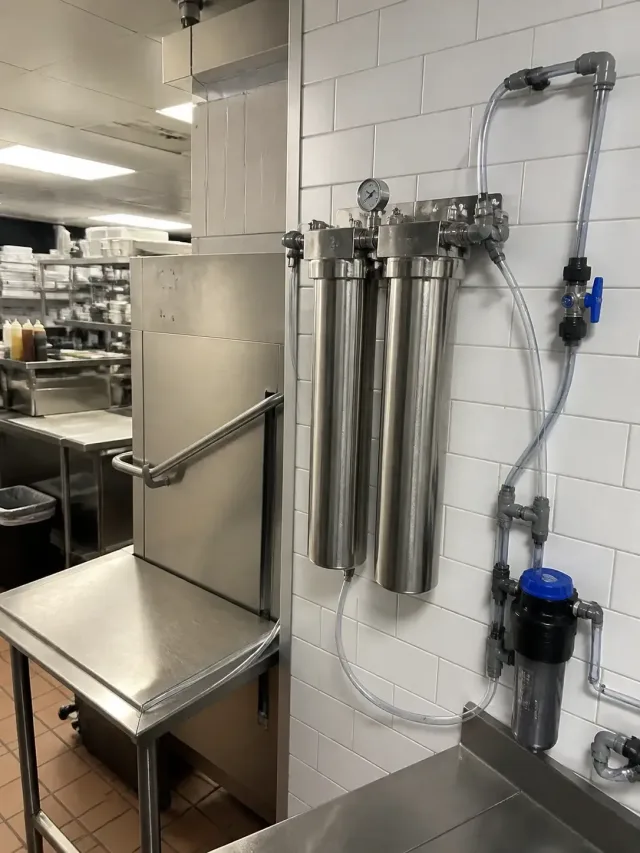
Water filtration system installed in a commercial kitchen facility in Mesa, AZ.

Commercial Water Treatment Solutions

Businesses in Mesa depend on water treatment to protect dishwashers, laundry equipment, boilers, fixtures, ice machines, and customer-facing operations. We design commercial systems around demand, flow rate, regeneration needs, grain capacity, and the equipment that hard water can damage.

  • High-capacity softeners from 48,000 grains to several hundred thousand grains when demand warrants
  • Duplex or triplex configurations for continuous soft water
  • Support for restaurants, hotels, laundries, car washes, and medical offices
  • Scheduled resin, valve, brine, and hardness verification
  • Treatment plans matched to flow rate and daily water consumption
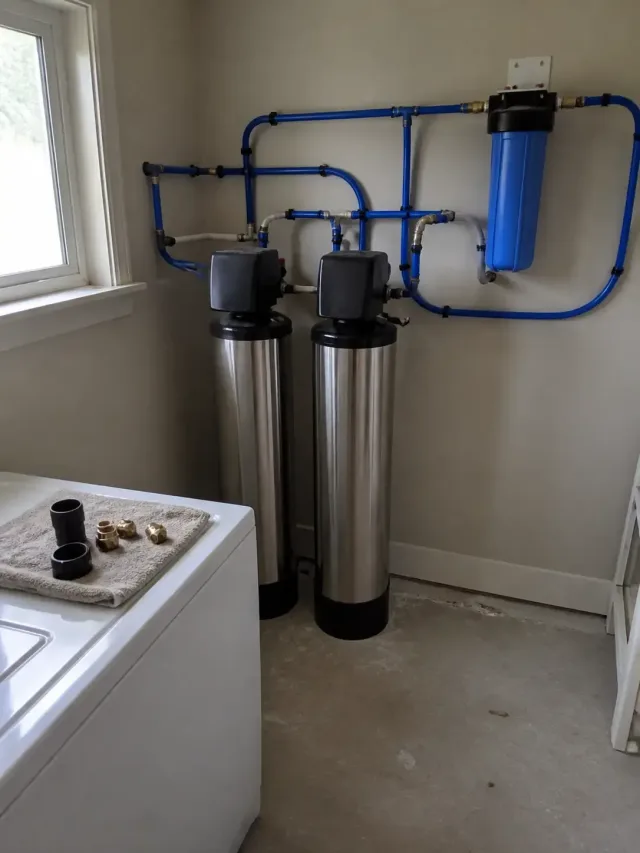
Water filtration system repair with new PEX tubing and tanks in a laundry room in Mesa, AZ.

Ongoing Service, Repairs & Optimization

A system installed years ago may need new settings, cleaning, repair, or output testing as water use and supply conditions change. We provide troubleshooting, preventive maintenance, and performance optimization using brine draw checks, valve diagnostics, resin inspections, salt dosage review, and tap hardness verification. That support helps protect resin capacity, control valve performance, RO cartridges, carbon media, and filtration stages over the life of the system.

  • Control valve, injector, venturi, and regeneration diagnostics
  • Resin bed inspection for degradation or iron fouling
  • Salt bridge, brine float, and brine draw checks
  • Salt dosage and regeneration frequency adjustments
  • Output hardness testing after service or repair
Built for Mesa Water Conditions

Why Choose Mesa Water Softeners

Mesa Water Softeners focuses on water softening and filtration for the conditions local customers actually experience: hardness that can exceed 300 parts per million, scale buildup, chloramine treatment, mixed older plumbing, and heavy residential or commercial water use. Our work combines local water-quality familiarity, Arizona plumbing awareness, practical equipment sizing, and clear recommendations for softeners, RO systems, whole-house filtration, carbon media, and maintenance support.

Local Water Quality Expertise

Mesa water conditions change by neighborhood and source blend, from Eastmark and Cadence to older areas near Dobson Road, downtown Mesa, and outer East Mesa near Apache Junction. We also consider public water entities and local features such as Salt River Project, Central Arizona Project canal water, and areas near the Granite Reef Diversion Dam when explaining why your test results may differ from another neighborhood. That local context helps us decide what to test, which treatment options make sense, and how to protect your plumbing over time.

Proper System Sizing

A water softener must match both tested hardness and actual water use. A typical four-person household may use roughly 75 gallons per person per day, and Mesa hardness in the 17 to 25 grains-per-gallon range often pushes sizing toward 32,000- to 48,000-grain capacity at minimum. We calculate capacity to avoid undersized equipment that lets hard water pass through and oversized equipment that wastes salt or regenerates inefficiently.

Clean, Licensed & Insured Workmanship

Our installations are performed by experienced, insured plumbing technicians, and our work is built around Arizona plumbing requirements and accessible service layouts. We keep pipe runs supported, valves labeled, drain lines routed correctly, and equipment placed so the system can be serviced safely. When a permit or inspection applies, our planning accounts for Arizona Registrar of Contractors requirements and City of Mesa Development and Sustainability expectations.

Tired of Hard Water Problems?

Common Water Problems in Mesa Homes

Hard water problems usually show up at the fixtures first, but the larger costs often build up inside appliances, water heaters, and plumbing. Mesa Water Softeners helps identify whether the issue is untreated hardness, a failing softener, poor system sizing, chloramines, sediment, iron, or a filtration gap. Because local hardness can exceed 300 parts per million, small symptoms like cloudy glassware or a crusted aerator can point to a whole-home water treatment issue.

Request Water Test

Scale on Fixtures and Showerheads

White or gray deposits on showerheads, faucet aerators, and tile are common signs of Mesa hard water. Those deposits come from calcium and magnesium minerals that remain after water evaporates, especially where water is heated or sprayed. A properly sized softener reduces the hardness minerals that form those deposits and make cleaning harder.

Water Heater Scale and Efficiency Loss

Scale inside a water heater can coat heating elements, reduce efficiency, and shorten appliance life. In hard-water regions, softener installation is often associated with longer appliance lifespans, with industry-reported improvements commonly discussed in the 30 to 50 percent range when systems are installed and maintained correctly. Treating hardness throughout the home helps protect the equipment that is most expensive to repair or replace.

Spotty Dishes and Cloudy Glassware

Hard water minerals can leave spots on dishes, cloudy glassware, and film in dishwashers. The problem is often most visible after heated drying cycles, when dissolved calcium and magnesium remain on glass and stainless surfaces. Softened water helps detergents rinse more cleanly and reduces the mineral residue that appears after wash cycles.

Soap Film on Skin and Hair

When hard water reacts with soap and shampoo, it can leave a film that makes skin feel dry and hair feel dull. The same hardness minerals that spot glass can reduce lather and make rinsing feel incomplete. Soft water allows soaps to lather and rinse more completely, which many Mesa residents notice quickly after installation.

Softener Salt Bridges and Resin Fouling

A softener can underperform because of salt bridges, resin bead degradation, iron fouling, incorrect regeneration programming, failed control valves, or injector and venturi problems. Repair and maintenance visits check brine draw, rinse sequences, resin condition, valve seals, and output hardness methodically. That helps identify the cause before hard water keeps passing through the system.

Chloramine Taste, Odor, and Sediment

Some Mesa households need filtration in addition to softening, especially when taste, odor, chloramines, iron, hydrogen sulfide odor, or sediment are part of the problem. Catalytic carbon media is often a better fit than standard carbon for chloramine treatment, while sediment pre-filters and iron reduction equipment can protect downstream softener resin. Whole-house filtration, carbon filtration, and RO can be paired with a softener when testing supports the combination.

How it works

Our Water Treatment Process

Our process is designed to move from facts to fit: test the water, understand usage, size the system, install it correctly, and verify performance before we leave. Testing can include hardness minerals, chloramines, iron, sediment, dissolved solids, taste, odor, and the baseline output needed to choose softening, reverse osmosis, or whole-house filtration. That approach helps Mesa customers avoid generic equipment choices and get treatment that matches the property.

01.

Test Your Water

We start by testing hardness and reviewing other factors that can affect taste, odor, plumbing, and system performance. Those results give us a baseline before we recommend a softener, whole-house filter, reverse osmosis system, carbon media, or repair. We explain readings in practical terms such as grains per gallon, mg/L, and what those numbers mean for scale, fixtures, and appliances.

02.

Review System Options

After testing, we explain which treatment options fit your water and which ones do not. You will understand the differences between salt-based softeners, saltless conditioners, reverse osmosis, catalytic carbon filtration, sediment filtration, and commercial system configurations. The goal is to match the equipment to Mesa water conditions rather than oversell features you do not need.

03.

Size the Equipment

We calculate capacity using water hardness, household or business usage, regeneration interval, and plumbing layout. For many Mesa homes, that means comparing tested hardness against daily gallons used, often starting with the common planning figure of roughly 75 gallons per person per day, and choosing an appropriate grain capacity before installation. Correct sizing helps avoid wasted salt, early breakthrough of hard water, and poor system performance.

04.

Install the System Cleanly

Our technicians install the equipment with organized piping, correct bypass valve setup, secure brine tank placement, and drain routing to an appropriate discharge point. We also account for Mesa plumbing layouts, older pipe materials, pre-plumbed softener loops in newer construction, and high ambient temperatures that can affect equipment placement. The result is a cleaner, easier-to-service system.

05.

Program, Test, and Walk Through

Once the equipment is installed, we program the control valve, verify regeneration settings, check connections, and test output water. For RO and whole-house filtration systems, we also confirm filter placement, storage tank setup, faucet connection, pressure behavior, or pre-filter flow as applicable. Before leaving, we explain salt maintenance, bypass operation, filter-change expectations, and what to watch for as the system starts working.

06.

Maintain and Optimize Over Time

We remain available for maintenance, troubleshooting, and performance optimization after installation. Follow-up service can include brine tank cleaning, valve checks, resin inspection, salt dosage adjustment, tap hardness verification, carbon media review, pre-filter replacement planning, and RO membrane or cartridge guidance. That continuity helps your system stay aligned with water use and supply conditions over time.

Water Softener Service Areas in Mesa and the East Valley

Mesa Water Softeners serves residential and commercial customers throughout Mesa, Maricopa County, and the surrounding East Valley. Mesa spans from the Tempe boundary toward Apache Junction and had a 2020 census population of 504,258, making it the 38th most populous city in the United States. Our service coverage includes newer communities, older central neighborhoods, commercial corridors, and nearby cities where hard water creates the same scale and appliance problems.

  • East Mesa
  • West Mesa
  • North Mesa
  • South Mesa
  • Central Mesa
  • Downtown Mesa
  • Eastmark
  • Cadence
  • Las Sendas
  • Dobson Ranch
  • Fiesta Area
  • Baseline Road Area
  • Mesa Drive Area
  • Superstition Corridor
  • Chandler
  • Gilbert
  • Tempe
  • Scottsdale
  • Apache Junction
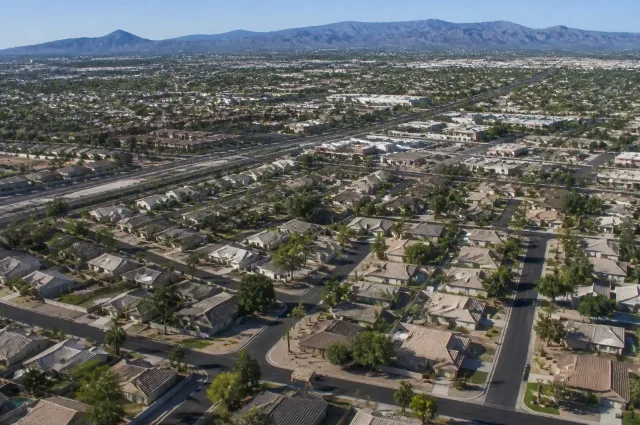
Aerial drone view of residential neighborhoods and road networks in Mesa, AZ under daylight.
Local Customer Feedback

What Mesa Water Treatment Customers Say

★ ★ ★ ★ ★

They tested our water first, explained why the system needed to be sized for our Eastmark home, and installed everything cleanly. The difference at the fixtures and dishwasher was obvious within the first week.

AL
Amanda L.Eastmark Homeowner
★ ★ ★ ★ ★

Our old softener was leaving spots again, and we thought it had to be replaced. The technician found a salt bridge and a valve issue, handled the repair, and showed us how to watch the salt level.

JR
Jason R.West Mesa Customer
★ ★ ★ ★ ★

We needed reliable soft water for our restaurant equipment, especially the dishwasher and ice machine. Mesa Water Softeners walked us through a commercial setup and built a maintenance plan that made sense for our usage.

PS
Priya S.Mesa Business Owner
★ ★ ★ ★ ★

They added reverse osmosis at our kitchen sink and helped us understand what whole-house filtration could do alongside the softener. The recommendations were practical and based on the water test, not a generic sales pitch.

MT
Michael T.North Mesa Resident
Get Better Water

Schedule a Mesa
Water Treatment
Consultation

Stop letting hard water scale, spotty dishes, dry-feeling skin, chloramine taste, sediment concerns, and appliance wear become normal parts of owning a Mesa property. Contact Mesa Water Softeners to schedule a consultation, review your water hardness, compare softening, RO, and whole-house filtration options, and get clear pricing before installation or service begins.

Water Softener Help

Water Softener, RO & Filtration Questions, Answered

Use these answers to understand water softener installation, reverse osmosis, whole-house filtration, sizing, repair, maintenance, and service coverage for Mesa and nearby East Valley communities.

Call Mesa Water Softeners

Water softener installation cost in Mesa depends on the equipment selected, whether the home already has a softener loop, and how complex the installation location is. Most residential projects fall between $1,800 and $5,500, with many homes landing around $2,400 to $3,800 for equipment and labor. Loop-ready homes can sometimes cost less because less plumbing work is required.

The right size is calculated from daily water consumption and tested hardness, then matched to a resin tank capacity that can run several days before regenerating. A typical Mesa household of four may use roughly 75 gallons per person per day. With local hardness often around 17 to 25 grains per gallon, many four-person homes need at least a 32,000- to 48,000-grain system.

Yes, reverse osmosis and water softening are commonly paired because they address different issues. The softener treats hardness throughout the home, while RO is usually installed at the kitchen sink or under the counter to reduce dissolved solids, nitrates, chlorine, chloramines, and other drinking-water concerns. A softener can also help protect the RO membrane from local scale pressure.

Whole house filtration makes sense when testing shows issues beyond hardness, such as sediment, iron, hydrogen sulfide odor, chlorine, or chloramines. A filtration system can be installed before the softener resin bed to protect downstream equipment and improve water quality at fixtures. Carbon, catalytic carbon, sediment, iron reduction, and multi-stage housings may be considered depending on test results.

Yes, Mesa hardness levels make a water softener a practical investment for many homes. Local tap water can measure above 300 parts per million and often falls in the 17 to 25 grains-per-gallon range, which can drive scale on fixtures, water heaters, dishwashers, and washing machines. Softened water helps reduce scale, improve soap lathering, and protect water-using appliances.

A permit may be required depending on the scope of plumbing work, especially if new loop connections are needed. Arizona plumbing work is governed by the Registrar of Contractors, and permitted work may involve the City of Mesa Development and Sustainability Department. We identify when permitting applies and plan the installation accordingly.

A standard residential installation in a home with an accessible existing plumbing loop usually takes two to four hours. Installations that require a new loop, longer drain runs, or work in tight mechanical spaces usually take longer. The appointment also includes programming, connection checks, and a walkthrough of salt and bypass operation.

A water test can identify hardness minerals such as calcium and magnesium and can also review chlorine or chloramines, iron, sediment, dissolved solids, taste, and odor indicators. Mesa's water can include Salt River Project and Central Arizona Project source blends, so test results can vary by neighborhood and supply conditions. Testing gives us the baseline needed to size a softener or recommend filtration.

For most Mesa households, a salt-based ion exchange softener with demand-initiated regeneration is the most effective choice because it removes hardness minerals. Saltless conditioners can make sense for sodium concerns or specific maintenance preferences, but they condition minerals rather than removing them. Testing helps decide whether ion exchange, saltless conditioning, RO, or added filtration is the right fit.

Schedule repair if you notice hard water returning, salt not dropping in the brine tank, too much salt use, error codes, failed regeneration, or leaks around the control valve or brine tank. Common repair issues include salt bridges, resin fouling, injector and venturi problems, brine draw failures, and valve seal wear. A careful diagnosis helps determine whether parts, cleaning, programming, or replacement is needed.

Routine maintenance can include brine tank cleaning, resin bed inspection, salt level checks, control valve testing, regeneration verification, salt dosage adjustment, and output hardness testing. A quality softener installed correctly and maintained properly typically lasts 15 to 20 years, so small service visits help protect the larger installation investment. Commercial systems need more frequent maintenance because they process higher water volumes.

Standard activated carbon is often used for chlorine, taste, and odor concerns, but chloramines can require a more specific media choice. Because Mesa municipal water is treated with chloramines rather than chlorine alone, catalytic carbon may be specified when the water test and treatment goal call for chloramine reduction. It can be used with a softener, sediment filtration, or RO as part of a staged system.

Yes, we design and install high-capacity commercial softeners for properties such as restaurants, hotels, laundry facilities, car washes, medical offices, and light manufacturing operations. Commercial systems are sized around daily flow rate, water consumption, grain capacity, and regeneration needs. Duplex or triplex configurations can be used when continuous soft water is required.

In addition to Mesa, Mesa Water Softeners serves Chandler, Gilbert, Tempe, Scottsdale, Apache Junction, and the broader Maricopa County area. Within Mesa, we work across East Mesa, West Mesa, North Mesa, South Mesa, downtown Mesa, Eastmark, Cadence, Las Sendas, Dobson Ranch, and nearby commercial corridors. Service recommendations are still based on water testing at the property, not just city name.