Mesa Water Is Very Hard
The direct answer is yes. Mesa sits above the very-hard cutoff, with reported tap-water hardness around 15.5-17.1 GPG depending on location and test method.
Yes, Mesa's tap water is very hard, with common readings around 292 PPM (mg/L), or 17.1 grains per gallon. Mesa Water Softeners tests hardness in local homes so residents can understand what is coming from their own tap before choosing a water softener.
The direct answer is yes. Mesa sits above the very-hard cutoff, with reported tap-water hardness around 15.5-17.1 GPG depending on location and test method.
Mesa blends Salt River Project surface water, Central Arizona Project allocations, and local groundwater wells. Seasonal blending and neighborhood supply zones can change the exact number at the tap.
A citywide average is useful, but it does not size equipment for a specific household. On-site hardness testing helps match softener capacity to water use and peak demand.
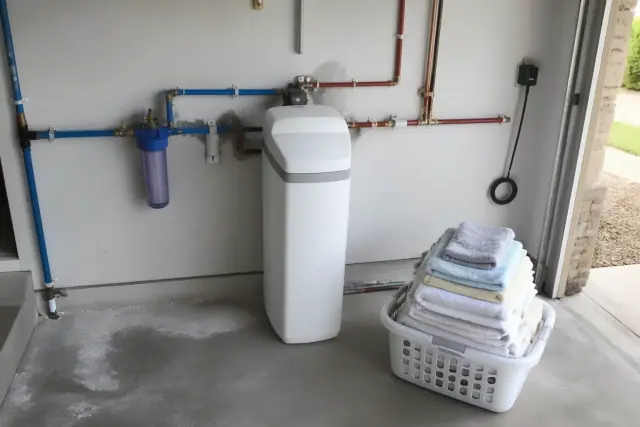
Crust on faucets, stiff towels, cloudy dishes, and dry-feeling skin are practical signs of the calcium and magnesium in Mesa tap water.
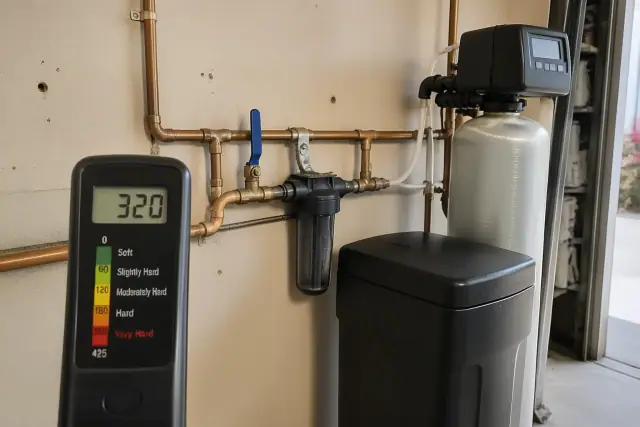
The U.S. Geological Survey scale treats anything above 180 PPM as very hard. Mesa readings near 265.4-292 PPM are not borderline; they are solidly in that top band.
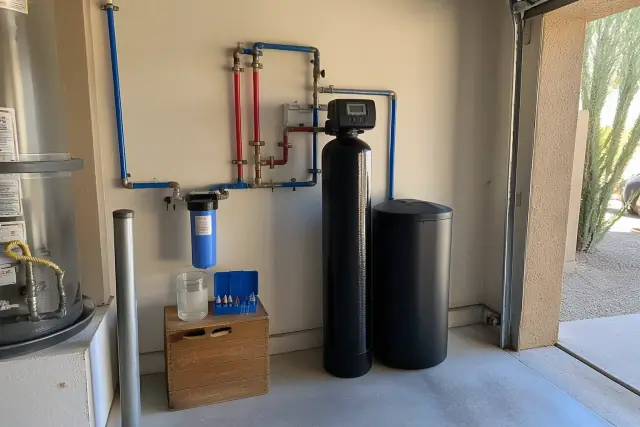
A hardness test takes about 20 minutes during a consultation. The result helps confirm whether softening is needed and how large the system should be.
Mesa water is commonly cited around 292 PPM (mg/L), which converts to 17.1 grains per gallon.
Independent readings can come in closer to 265.4 PPM, or 15.5 GPG, because source blending and testing locations vary.
Scale buildup can affect fixtures, plumbing, dishwashers, clothes washers, and water heaters before a homeowner connects the problem to hardness.
Do not size a softener from a citywide average alone. Confirm the home, usage habits, and tap reading before approving equipment.
| Hardness Band | PPM (mg/L) | What It Means in Mesa |
|---|---|---|
| Soft | 0-60 | Mesa is far above this U.S. Geological Survey band. |
| Moderately hard | 61-120 | This is still well below typical Mesa tap readings. |
| Hard | 121-180 | Very hard begins above 180 PPM, or about 10.5 GPG. |
| Mesa range | 265.4-292 | About 15.5-17.1 GPG, which is firmly very hard. |
Very hard water is not described in the draft as a health hazard, but it is a household performance problem. The source connects Mesa hardness with scale on water heaters and fixtures, cleaner dishes after softening, better-feeling laundry, and reduced appliance maintenance pressure within the first year.
The hard-water answer is consistent across Mesa, but the exact tap reading can shift by utility supply zone and seasonal blending. East-side and west-side neighborhoods can see small differences while still testing in the very-hard range.
The usual follow-up questions are whether Mesa water is safe, what causes the hardness, and what removes it. The draft says Mesa water meets Arizona Department of Environmental Quality and EPA drinking water standards, while hardness itself comes from calcium and magnesium and is removed by ion exchange softening.
Send a few details about the home and the hard-water symptoms you are seeing. A local hardness test can confirm the tap reading, common contaminants, and the right softener size before you approve equipment.