Worth It at the Kitchen Tap
Point-of-use RO at the kitchen sink usually gives Mesa homeowners the clearest return because it treats the water used for drinking and cooking without filtering every fixture.
Mesa Water Softeners often hears this question from homeowners dealing with white scale, mineral-heavy taste, or chlorine aftertaste at the kitchen tap. Reverse osmosis is usually worth it when you want better drinking and cooking water, but the right setup depends on your water source, household usage, and whether a softener already protects the RO membrane.
Point-of-use RO at the kitchen sink usually gives Mesa homeowners the clearest return because it treats the water used for drinking and cooking without filtering every fixture.
Mesa's blend of Salt River Project surface water and Salt River Valley aquifer groundwater is safe to drink, but its mineral load can leave scale, flat taste, and higher TDS at the tap.
A water test should check hardness, TDS, pressure, and household usage before anyone recommends under-sink RO, whole-house RO, or a softener-plus-RO setup.
A kitchen sink, drinking glass, or faucet with visible white scale and clear water. These are the everyday signs that lead Mesa homeowners to compare RO options.
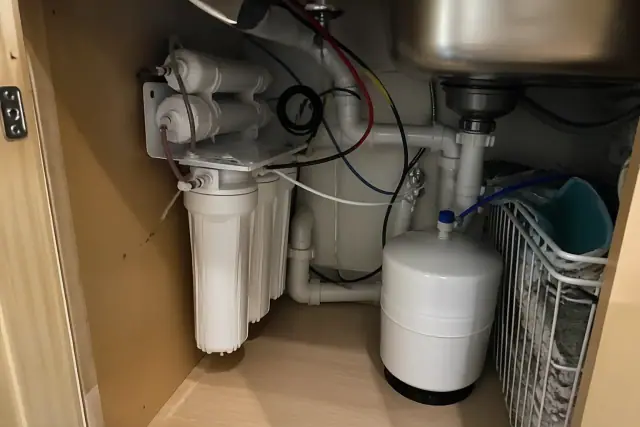
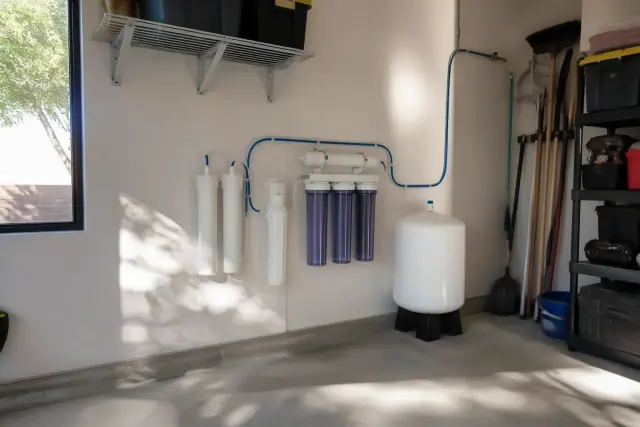
Compare a compact under-sink unit with a larger whole-house setup. This image helps make clear why drinking-water treatment is different from property-wide filtration.
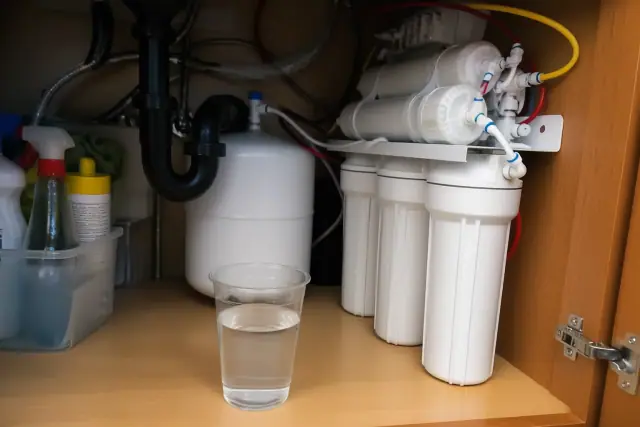
A simple water test at the tap with a TDS meter or sample vial. Testing is what separates a useful RO recommendation from a default equipment package.
Start with hardness, TDS, and incoming pressure, then confirm whether a softener is already protecting the plumbing before the RO membrane.
Household drinking-water volume, existing softening, source water, available cabinet space, and the desire for remineralization can all change the right RO setup. A family of four using RO for cooking and drinking may see $5-15 added to the monthly water bill, so usage should be part of the recommendation.
Act sooner if chlorine taste returns, TDS readings rise, the tank fills slowly, or an older system has gone longer than its filter schedule.
Avoid defaulting to the largest system, skipping shutoff valves, or ignoring drain-line details; those mistakes can mean wasted water, slow leaks, or reduced output.
| Decision Point | What It Means in Mesa | Recommended Action |
|---|---|---|
| Drinking and cooking water | Point-of-use RO usually gives the best value because it targets taste, TDS, and residual contaminants at the kitchen tap. | Compare an under-sink system before considering whole-house RO. |
| Hardness and scale | Mesa water is often in the 12-17 grains per gallon range, so a softener upstream can help protect the RO membrane. | Test hardness and confirm whether pre-treatment is already in place. |
| Cost and maintenance | Basic under-sink RO often runs $200 to $600 installed, with filters every 6-12 months and membranes every 2-5 years. | Budget for filter replacements before choosing system size. |
| Whole-house RO | Whole-house systems can cost $2,500 to $4,000 or more and may use about 2 gallons to produce 1 gallon of purified water. | Use whole-house RO only when testing shows a property-wide need. |
Reverse osmosis is a drinking-water upgrade, not a warning that Mesa tap water is unsafe. The city's municipal supply meets Arizona Department of Environmental Quality and EPA Safe Drinking Water Act standards, but the Salt River Project surface water and Salt River Valley aquifer blend can still taste mineral-heavy. RO is most useful when you want a cleaner-tasting kitchen tap and lower dissolved solids for drinking, coffee, ice, and cooking.
Maintenance and performance matter as much as the initial equipment choice. Standard under-sink systems usually need $50-150 per year in filters, sediment and carbon pre-filters every 6-12 months, and Mesa homes may do better on a 6-9 month schedule because of hard water and higher TDS. Most residential systems produce 50-100 gallons per day, but output can slow as membranes age, when incoming pressure drops below 40 psi, or in some older Mesa neighborhoods and east-side higher elevation areas. Depending on system age, wastewater can be roughly 2-4 gallons for every 1 gallon produced; older RO designs may be closer to 3-4 gallons, while newer demand-initiated designs can reduce that ratio.
The common follow-ups are whether RO water is safe, whether mineral removal matters, and whether a homeowner can install a system without help. RO has been used in municipal and residential treatment for decades, and the water is safe for most people eating a normal diet, but it does remove calcium, magnesium, and other beneficial minerals along with contaminants; a remineralization cartridge can help if taste is a concern. RO is not a substitute for municipal disinfection because membranes are not designed for bacteria, viruses, or dissolved gases such as radon, and professional installation helps avoid improper fittings, skipped shutoff valves, and slow under-sink leaks.
Share what you notice at the tap and what your household uses drinking water for each day. A local water test can confirm hardness, TDS, pressure, and system fit before you approve equipment.