Softener: Hardness Removal
A softener exchanges calcium and magnesium ions for sodium or potassium ions, which is why it helps stop scale on faucets, glass, pipes, and water heaters.
Mesa Water Softeners helps Mesa homeowners separate hard-water problems from filtration problems before they choose equipment. A water softener removes calcium and magnesium that cause scale, while a whole house filter targets chlorine, sediment, and certain contaminants. Because Mesa water often has both hardness and chlorine concerns, the right answer usually starts with testing rather than guessing.
A softener exchanges calcium and magnesium ions for sodium or potassium ions, which is why it helps stop scale on faucets, glass, pipes, and water heaters.
A whole house filter uses media or cartridges to reduce chlorine taste, odor, sediment, grit, and selected contaminants before water reaches fixtures.
Testing the actual tap for hardness, chlorine, iron, and sediment shows whether the home needs a softener, a filter, or a combined setup.
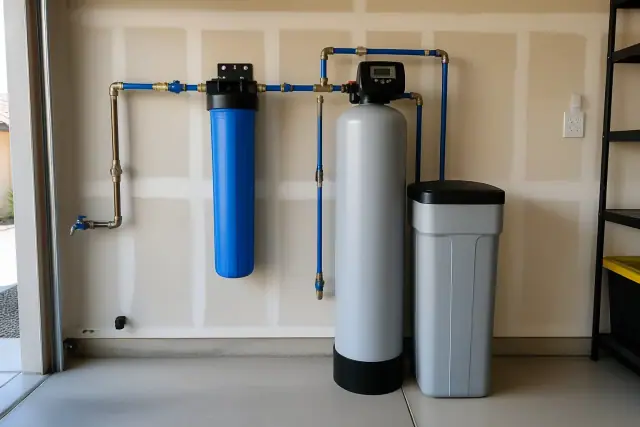
White mineral scale on a faucet, shower glass, or water-heater connection. This makes the softener's job visible.
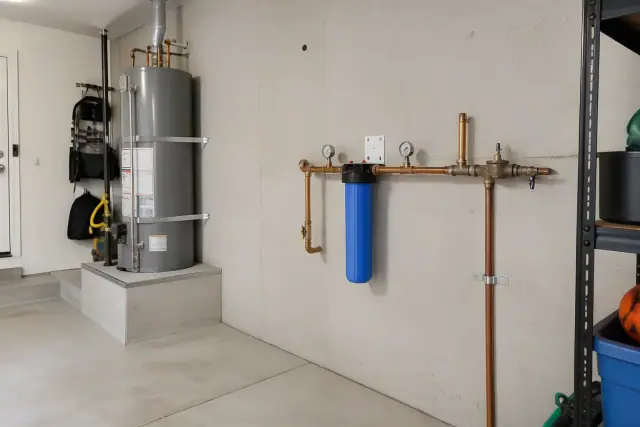
A sediment or carbon filter installed where water enters the home. The visual should make clear that filtration happens before fixtures, not only at one tap.
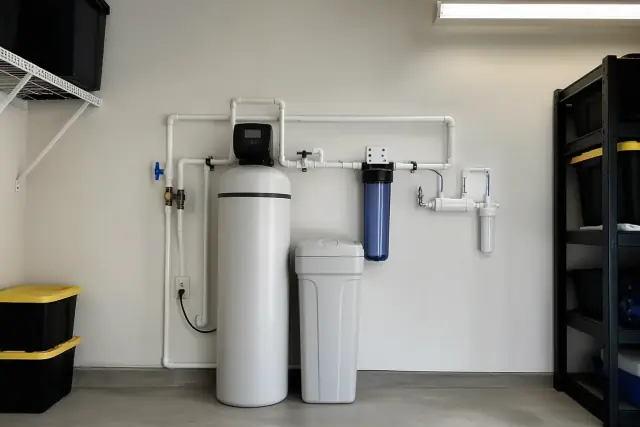
The difference between whole-house treatment and an under-sink reverse osmosis drinking tap. Mesa homes may use all three for different water-quality goals.
Test the home's actual water before buying equipment. Mesa's municipal supply often carries 12 to 17 gpg hardness, but chlorine, iron, sediment, and usage still change the recommendation.
The softener handles the two hardness minerals, calcium and magnesium. The filter handles chlorine, sediment, odors, grit, and selected contaminants through media rather than ion exchange.
Scale plus chlorine odor, sediment, or older galvanized plumbing points toward a combined system. Mesa homes in Eastmark, Las Sendas, and older Dobson Ranch neighborhoods are examples where testing often supports more than one treatment stage.
Do not expect a carbon or sediment filter to stop hard-water scale, and do not expect a softener to remove chlorine or bacteria. Bacteria concerns require targeted testing and treatment rated for microbial reduction.
| Water Symptom | What It Points To | Recommended Action |
|---|---|---|
| White scale, spotting, or poor soap lather | Hardness minerals such as calcium and magnesium; Mesa water commonly tests around 12 to 17 gpg. | Test hardness and size a softener for household usage. |
| Chlorine taste, odor, grit, or fouled aerators | A filtration problem involving chlorine, sediment, or particulate. | Compare sediment and carbon filtration stages and plan cartridge changes every 3 to 12 months. |
| Scale plus chlorine odor or sediment | Both treatment categories may be needed in the same plumbing run. | Pair a demand-initiated softener with sediment and carbon filtration. |
| Well water with iron, sediment, and hardness | Iron above roughly 0.3 ppm can foul standard softener resin. | Use targeted testing before selecting the pretreatment order. |
A water softener is not a better filter, and a whole house filter is not a salt-free softener. Mesa's groundwater and Salt River Project surface-water blend can create both mineral scale and disinfectant taste concerns, so the practical answer depends on the symptom, the test result, and where the equipment will be installed.
Household size, grain capacity, valve type, private-well conditions, and contaminant levels all affect the recommendation. Typical installed softener systems run roughly $1,200 to $3,000, while whole house filtration often runs $600 to $2,500; maintenance can add $10 to $25 per month for softener salt or potassium pellets and about $50 to $200 per year for filter cartridges. Cartridges often need replacement every 3 to 12 months, and most residential softener installations are completed in a single day with bypass valves for future service.
A standard sediment or carbon filter is not designed to remove bacteria; microbial concerns need testing and treatment such as ultraviolet equipment or a process rated under NSF/ANSI 53 or 58. Softener performance is tied to ion-exchange technology recognized under NSF/ANSI 44 testing, while reverse osmosis is usually a point-of-use drinking-water system that removes dissolved solids down to a fraction of a micron. For outlying Mesa wells near Queen Creek and Apache Junction, iron, sediment, and hardness may all need to be checked before deciding what goes first.
Share what you are seeing at the tap, shower, or water heater. Mesa Water Softeners can test for hardness, chlorine, iron, and sediment, then explain whether a softener, filter, reverse osmosis unit, or combined setup makes sense.