Daily Grain Need
Start with people x 80 gallons x measured GPG. A four-person Mesa home at 12.8 GPG needs 4,096 grains removed per day before any weekly capacity margin is added.
Mesa Water Softeners sizes water softeners around tested hardness and real household use, because a generic chart can miss how hard Mesa water is. The right size balances grain capacity, flow rate, salt use, and regeneration timing so a home gets consistent soft water without wasted capacity.
Start with people x 80 gallons x measured GPG. A four-person Mesa home at 12.8 GPG needs 4,096 grains removed per day before any weekly capacity margin is added.
Mesa hardness commonly falls between 11 and 17 GPG, so capacity alone is not enough. Homes with 2.5 or more bathrooms also need flow capacity around 9 to 12 GPM.
Confirm actual hardness, chlorine, iron, sediment, fixture count, and usage patterns before choosing a 24,000, 32,000, 40,000, or 48,000 grain unit. Well pockets, older galvanized plumbing, and newer Salt River Project-fed areas can test differently even a few blocks apart.
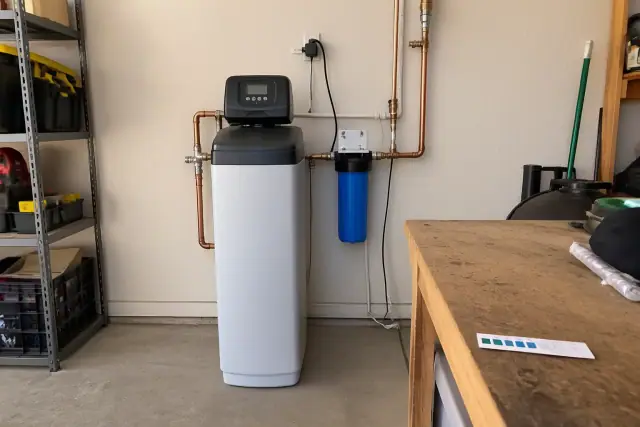
A water test kit or report with GPG marked. The final system size should start with measured hardness, not a citywide average.
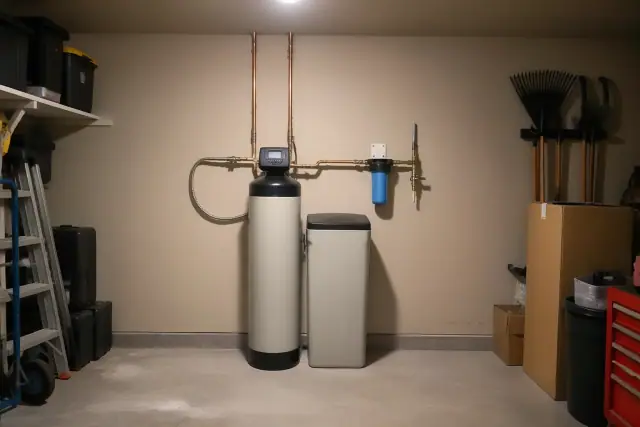
Bathrooms, laundry, dishwasher, and outdoor water demands together. Peak flow matters when several fixtures run at once.
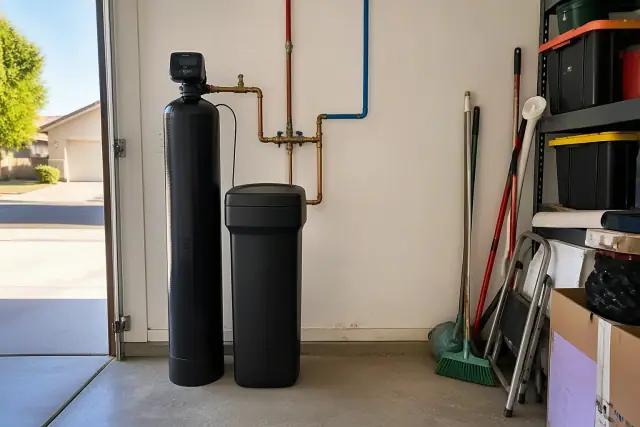
Residential size tiers from 24,000 to 48,000 grains. The visual should make clear why family size and Mesa hardness shift the recommendation.
Use people x 80 gallons per day x measured GPG to estimate daily grain demand, then multiply by 7 when you want roughly a weekly regeneration target.
For municipal water around 12.8 GPG, family-of-four math points near 32,000 grains before efficiency margin. Larger 4 to 5 person households often move into the 40,000 to 48,000 grain range.
Higher fixture counts, pools, evaporative cooling, outdoor spigots on the softener, iron, sediment, or well water can push the recommendation toward larger or dual-tank equipment.
Do not buy the largest tank by default. A severely oversized unit can regenerate too infrequently and leave water sitting in the resin bed too long.
| Household | Daily Grain Need at 14 GPG | Weekly Target | Typical Residential Fit |
|---|---|---|---|
| 2 people | 2,240 grains | 15,680 grains | 24,000 grain softener |
| 3 people | 3,360 grains | 23,520 grains | 24,000 to 32,000 grains |
| 4 people | 4,480 grains | 31,360 grains | 32,000 grain softener |
| 5 people | 5,600 grains | 39,200 grains | 40,000 to 48,000 grains |
| 6 people | 6,720 grains | 47,040 grains | 48,000 to 64,000 grains |
Water softener size is not the cabinet footprint; it is how much ion exchange resin capacity the unit has before regeneration. One GPG equals roughly 17.1 milligrams of calcium and magnesium carbonate per liter, and anything above 10.5 GPG is very hard water by U.S. Geological Survey standards.
The final size changes with household size, bathrooms, measured hardness, iron or sediment, pool top-offs, evaporative cooling, irrigation drip use, and whether every fixture is treated by one whole-house unit. Mesa draws from Salt River Project and Central Arizona Project canal systems along with groundwater wells, so testing matters more than assuming one citywide hardness number.
A properly sized residential system often regenerates every 5 to 12 days, and metered valves do it based on actual water use. A 24,000 grain softener may fit one person or a couple, but in Mesa's 12 to 17 GPG water it can exhaust in 2 to 3 days for a family of four. A 30,000 grain unit generally suits 2 to 3 people locally, while a family of four may see that size regenerate every 3 to 5 days.
Send your household size, bathroom count, and any hard-water symptoms you are seeing. A local water test can confirm hardness, chlorine, iron, sediment, and the right grain capacity before installation.